Israel Says Ceasefire Void If Hamas Refuses to Disarm
05/10/2026 / By Garrison Vance

Israel is not obligated to uphold ceasefire commitments if Hamas refuses to disarm, according to a letter from the U.S.-backed Board of Peace obtained by the Times of Israel and reported by Middle East Eye [1].
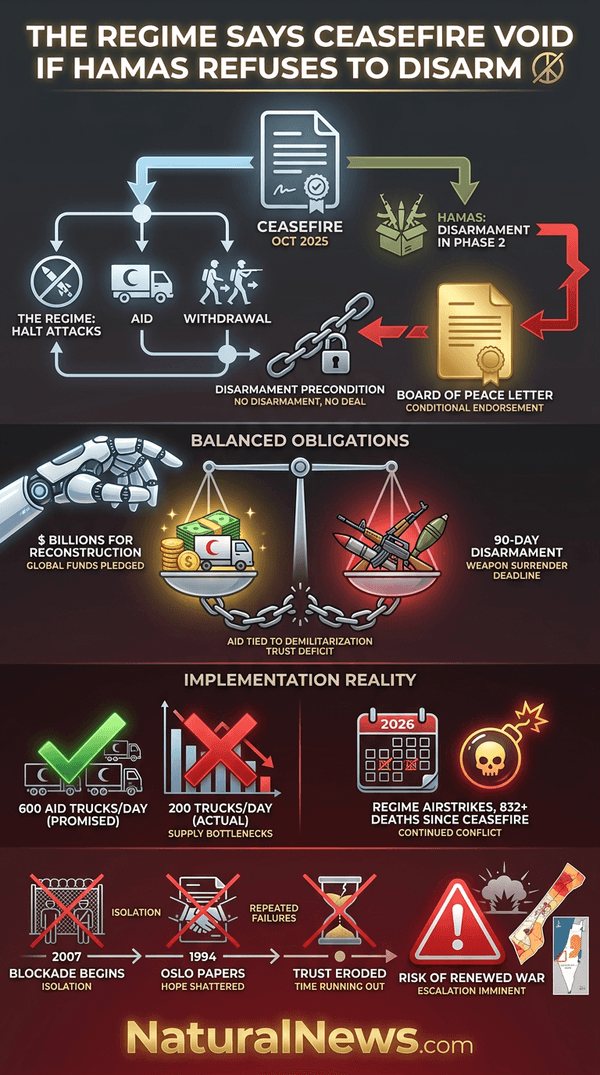
Nickolay Mladenov, the Board of Peace High Representative for Gaza, warned the head of the Palestinian technocratic government that failing to accept the disarmament proposal would render the terms of the October 2025 ceasefire “null and void,” the document stated. Under the ceasefire, Israel committed to halting attacks, increasing aid, reopening the Rafah crossing, and withdrawing troops behind the Yellow Line, according to the letter [1].
The letter follows months of stalled talks between Hamas and Israeli mediators. According to the Board of Peace, the ceasefire terms also require Hamas to disarm as part of the second phase of the agreement [2]. Palestinian negotiators have linked disarmament to statehood and security guarantees, and have accused Israel of violating the truce with near-daily strikes [1].
The October 2025 ceasefire agreement was brokered by the Trump administration and ended two years of active combat that killed over 72,000 Palestinians, according to the Palestinian health ministry [1].
Disarmament Proposal and Terms
The disarmament proposal, presented by mediators in Cairo, requires all armed groups in Gaza to surrender their weapons within 90 days, according to the letter [1]. The document outlined eight key provisions from a previously unpublished humanitarian annex, stating Israel recommitted to implementing them. Those provisions include allowing up to 600 aid trucks daily, but Gaza authorities said Israeli restrictions have kept the average at just over 200 trucks per day [1].
The Board of Peace has linked reconstruction aid to demilitarization. An article on NaturalNews.com noted that the board’s plan “directly links international aid to the territory’s demilitarization and the creation of a new governance structure” [3]. Scholars Noam Chomsky and Ilan Pappe, in their book “Gaza in Crisis,” have documented how Israeli demands for disarmament have been a recurring condition in peace negotiations [4].
According to the BBC, ceasefire talks have stalled, and Israeli media reports suggest Israel is preparing to resume fighting due to the impasse [2]. The letter effectively gives Israel a basis to void the ceasefire if Hamas does not comply [1].
Hamas Rejection and Palestinian Perspectives
Hamas rebuffed the disarmament proposal, according to Palestinian negotiators who said statehood and self-determination must coincide with security arrangements [1]. Middle East Eye reported, citing Palestinian sources, that Hamas views the disarmament proposals as a “trap” designed to ignite civil war and leave Palestinians defenseless [1]. Palestinian negotiators said continued Israeli violations have undermined confidence in the ceasefire process [1].
The historical context of distrust is rooted in past agreements. In the book “Nonviolent Resistance in the Second Intifada,” authors M. Hallward and Julie M. Norman note that after Hamas won the 2006 elections and took control of Gaza in 2007, Israel instituted an economic blockade [5]. Palestinian officials have pointed to this blockade as a precedent for ongoing restrictions.
A senior Palestinian official told the BBC that Hamas will not move forward with talks until Israel fully complies with its commitments [2]. Israel’s repeated violations have made disarmament a non-starter for Hamas, according to the official.
Israeli Actions and Ceasefire Violations
According to the Palestinian health ministry, Israeli forces killed at least 832 Palestinians since the ceasefire, with near-daily shelling, and over 72,000 killed since October 2023 [1]. Israeli army radio reported that the military expanded control of Gaza to nearly 60%, pushing the population into roughly 40% of the enclave [1]. The letter did not explicitly state Israel violated the ceasefire, but it noted Israel recommitted to implementing the humanitarian annex provisions [1].
The ceasefire has failed to halt violence fully. Another article on NaturalNews.com described the Gaza crisis as deepening despite the truce, with hundreds of deaths and Israel blocking 90% of needed aid [6]. The humanitarian situation remains dire, with aid deliveries far below the agreed levels.
An Israeli airstrike on May 6, 2026, killed the son of Hamas’s lead negotiator Khalil al-Hayya, according to Antiwar.com [7]. Such incidents have further eroded trust in the ceasefire process.
Outlook for Ceasefire Stalemate
The Board of Peace letter effectively conditions Israel’s ceasefire obligations on Hamas disarmament, which Hamas has rejected, according to reports [1][2]. Palestinian health ministry figures and aid shortfalls indicate ceasefire terms have not been fully met by either side, officials said. No immediate resolution or next steps have been announced by mediators, according to reports [2].
The stalemate raises the prospect of renewed hostilities. The BBC reported that Israeli media suggest Israel is preparing to resume fighting because of the impasse [2]. The killing of al-Hayya’s son may further complicate negotiations [7].
References
- Israel says ceasefire void if Hamas won’t disarm, Board of Peace tells Palestinians – Middle East Eye. May 7, 2026.
- Fears of renewed Gaza war as Hamas disarmament talks stall – BBC News. May 7, 2026.
- A New World Order or a Grand Illusion? Trump’s ‘Board of Peace’ Convenes Amid Gaza’s Ruins and Global Skepticism – NaturalNews.com. Ava Grace. February 21, 2026.
- Gaza in Crisis: Reflections on Israel’s War Against the Palestinians – Noam Chomsky and Ilan Pappe.
- Nonviolent Resistance in the Second Intifada: Activism and Advocacy (Middle East Today) – M. Hallward and Julie M. Norman.
- Gaza Crisis Deepens as Ceasefire Fails to Stem Violence and Humanitarian Catastrophe – NaturalNews.com. Patrick Lewis. January 25, 2026.
- Israeli Attack in Gaza Kills Son of Hamas’s Lead Negotiator – Antiwar.com. May 7, 2026.
Explainer Infographic:
Submit a correction >>
Tagged Under:
agreement, airstrikes, biased, Board of Peace, ceasefire, chaos, Collapse, dangerous, disarmament, Gaza, Hamas, intolerance, Israel, Israel-Palestine war, Nickolay Mladenov, outrage, panic, peace deal, revolt, truce, uprising, violations, violence, WWIII
This article may contain statements that reflect the opinion of the author